Everything on this site was built with AI coding agents. I decide what gets built and how it should feel, and I check the result. The agents write almost all of the code. That is not a shortcut: it's a different kind of work, and it took a while to find a way that produces things I actually trust.
Here is the workflow.
1. Write the product down first
Every project starts with two files:
- PRODUCT.md: who uses it, in what situation, what success means, and what must never happen. For the house dashboard, the first rule is "there is a lived-in house on the other end". Automated tests may never switch a real light.
- DESIGN.md: the visual rules. Fonts, colours and spacing, but above all the bans: "no glass effects on buttons", "yellow only means on", "no sliders".
Agents forget, and so do I. Written rules don't.
2. One agent builds, several review
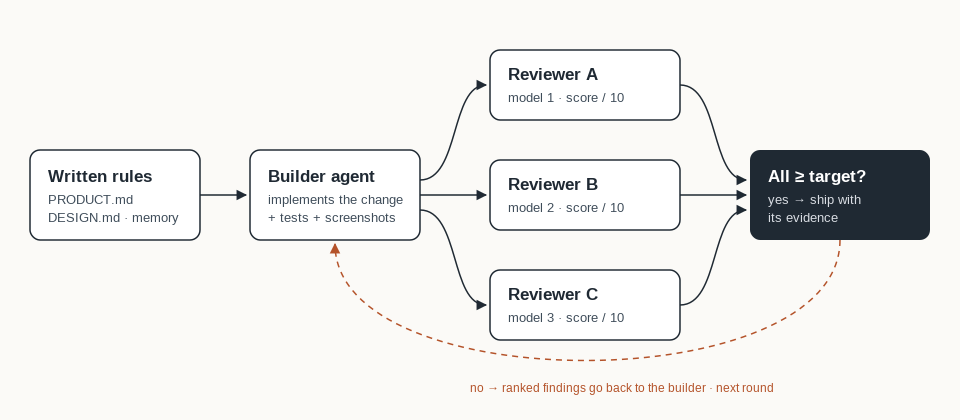
For anything bigger than a small fix, I run a council:
- One agent implements the change.
- Several different models review it independently. I use models from at least two vendors, because they miss different things. Each gives a score out of 10 and a ranked list of problems.
- The builder fixes the problems, and the reviewers score again.
- This repeats until every reviewer reaches the target. Usually that's 9.5 or 9.8. Some projects took more than ten rounds.
It's slower than accepting the first result, and it catches a lot more: layouts that break at one specific screen size, error messages written in developer jargon, a permission granted to every page when it should go to one.
3. Evidence, not claims
An agent saying "done, all tests pass" is a claim, not evidence. So every release comes with its own evidence:
- what was tested automatically, and how
- what was checked by eye: screenshots in light and dark mode, small and large screens, German and English
- what was not tested and still needs a human
The Murmur repository holds an evidence folder with validation reports and screenshots for its releases. That habit has saved me more than once.
4. A memory across projects
Agents start every session from zero. To fix that, a shared memory service records decisions and their reasons from every session across all projects, for example why the blinds work like push buttons or which group addresses must never be read. A new session can look these up before it changes anything.
The catch: memory describes the past. The rule is to check what memory says against the current code before acting on it.
5. Privacy is a design input
Many of these projects touch very personal data: the house, cameras, notes, documents. A few rules hold everywhere:
- Local first: speech recognition, video detection and presence detection run on my own hardware.
- No secrets in code, commits or logs.
- An AI agent can't read anything it doesn't need. Where it does read personal notes, a filter and an audit log come first.
- Before anything goes public, it gets anonymised, and that includes this website.
What I've learned
- Taste is the job. The agents can build almost anything. Knowing what good looks like, and saying no, is the part that's still on me.
- Small, reversible steps. Commit often. Keep a backup of the last working version. Never let an agent "clean up" without a way back.
- Hard limits beat good intentions. "Never send a command in tests" works better as a block in the test browser than as a polite request.
Tools I use: Claude Code and Codex as builders and reviewers, T3 Code to run several agents side by side, Obsidian for notes, and a self-hosted memory service.